Real change
rarely comes
through more analysis

Every safe experience
gently writes a
new pathway in the brain
and slowly the
past loosens its grip
Returning to Yourself
Much of what we call symptoms are simply the body asking for safety again.
Sometimes life simply becomes too much.
Your thoughts keep racing.
Your body feels tense or exhausted.
Emotions move through you without fully understanding why.
From the outside everything may look fine —
but inside there may be pressure, sadness, anxiety, or a quiet sense that something is not quite right.
As human beings we have evolved for millions of years as mammals. Our nervous systems developed in small groups where safety, stress, and emotion were shared and regulated through connection with others. In those environments, fear did not have to become chronic.
Today many people live more in their thinking mind than in their bodies. Safe, attuned relationships have become more rare, and the nervous system can remain in a subtle state of alertness.
In my therapy practice in Amsterdam I often meet people who function well intellectually and analytically, yet feel stuck physically and emotionally.
We are wired for connection
As human beings we have evolved for millions of years as mammals. Our nervous systems developed in small groups where safety, stress, and emotion were shared and regulated through connection with others. In those environments, fear did not have to become chronic.
Today many people live more in their thinking mind than in their bodies. Safe, attuned relationships have become more rare, and the nervous system can remain in a subtle state of alertness.
In my therapy practice in Amsterdam I often meet people who function well intellectually and analytically, yet feel stuck physically and emotionally.
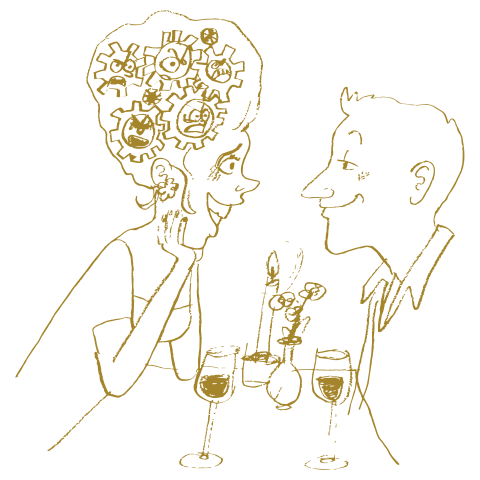
Body and mind form one intelligent system.
Survival strategies that were once necessary can later keep you stuck. When life becomes stressful, the body often returns to old patterns — not because you are failing, but because your system is trying to protect what was once vulnerable.
Real change rarely comes through more analysis.
It arises through embodied experience.
In therapy we learn to work with triggers differently: noticing what happens in the body, staying present with it, and gently guiding the nervous system toward regulation.
Over time the body begins to learn:
I can feel this — and it is still safe.
That is neuroplasticity in action.
Revisiting old patterns
Old patterns appearing again is not a setback, but often part of the process of change. Trauma is not only what happened, but what became frozen in the nervous system — and what has been stored can also transform.
Together we explore where your system once had to survive, and what it now needs in order to live.
Healing is rarely a straight line,
but a process of recognizing patterns sooner
and responding with greater gentleness.
Not to become someone else.
But to return to yourself.
We are
not designed
to heal in isolation
The nervous system
learns safety through relationship

How we begin
- Step 1
First (paid) session
We begin with a single session — online or in person,
depending on what feels most supportive for you.
This first meeting is mainly about sensing
whether your process can safely begin here.
This session allows us to:
- explore whether my way of working resonates with you
- notice how your body, emotions, and nervous system respond
- sense whether there is enough safety and attunement to continue
- Step 2
Intake
If the first meeting feels right, you will receive an intake form.
This helps us carefully map your history, current situation, and capacity —
without forcing anything, without pushing.
Everything unfolds at a pace your system can handle.
- Step 3
First series of sessions
After the initial meeting, we usually plan a first series of five sessions
(preferably every two to three weeks),
allowing continuity and a sense of safety to develop.
The focus is not on letting things go because we “should,”
but on gradually cultivating:
- more safety in your body and nervous system
- space to feel what is truly present
- movement toward what feels right and meaningful for you
As this foundation strengthens, change often begins to unfold naturally.
If this approach resonates with you,
you are welcome to reach out:
- by phone, message, or email
- or by scheduling a first session through the website
We will simply begin by exploring
whether this work feels right for you.
Usefull information about the Individual therapy sessions
Cost per individual therapy session
- Duration per session: 60 min
- Cost per session: € 120,-
- Student cost per session: € 100,-
Will my health insurance cover these sessions?
